Icons for our time
Alexandre Baker
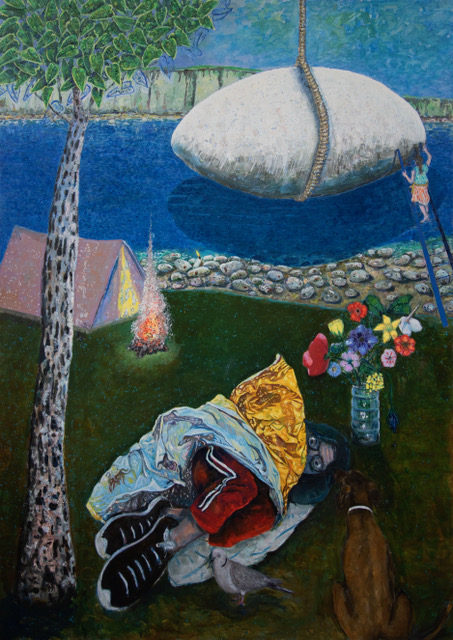
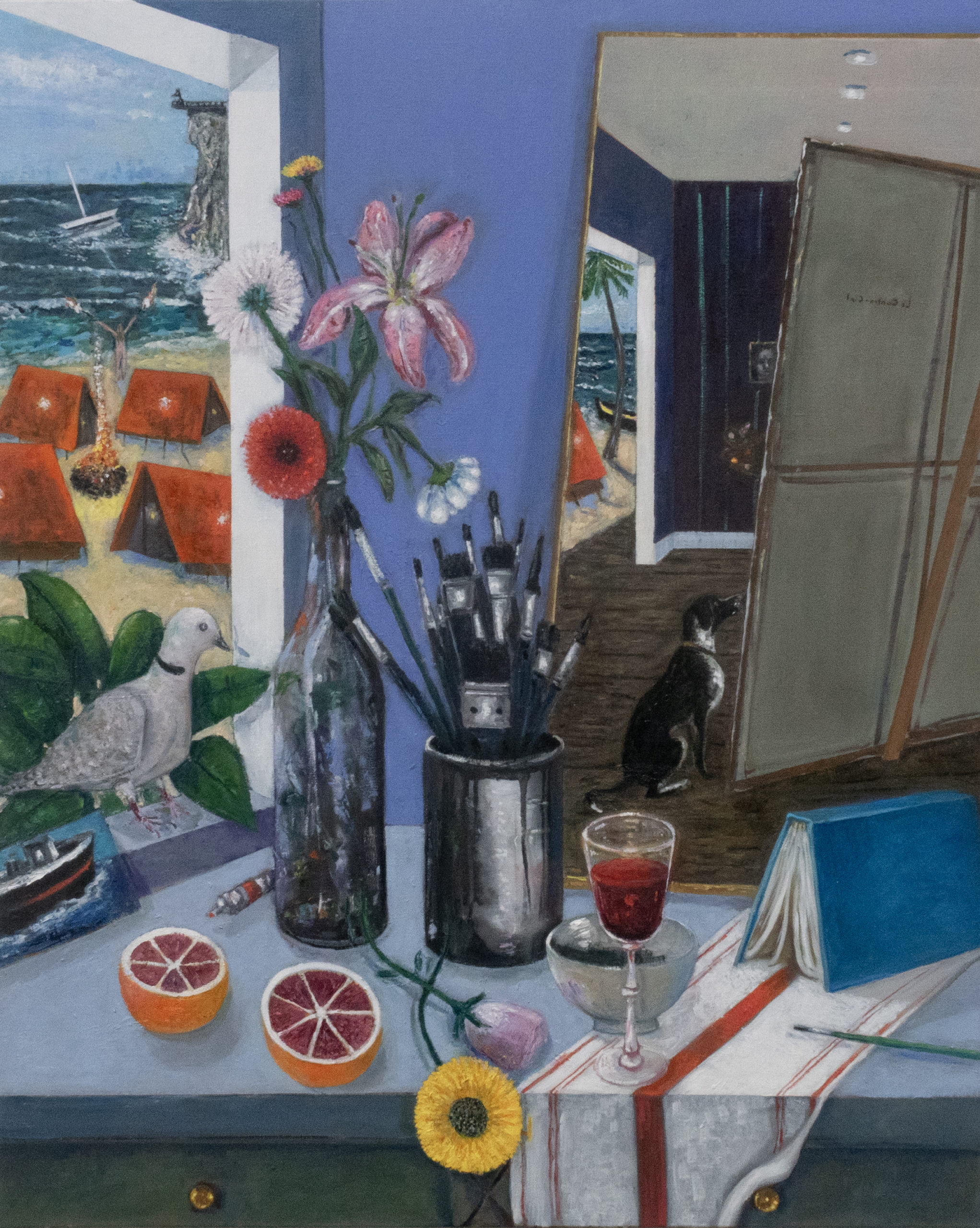
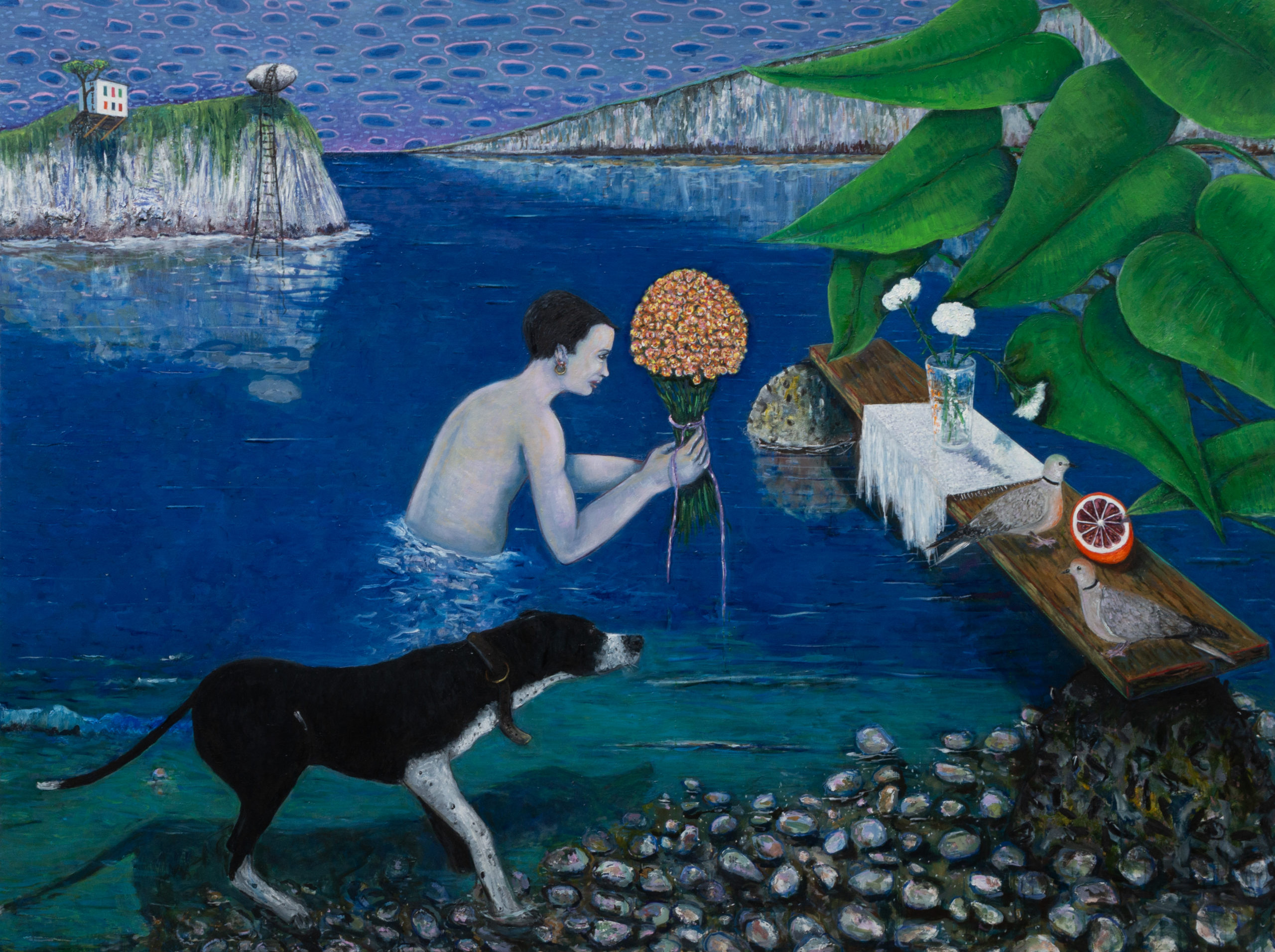
Compared even with the most unabashedly figurative of contemporary painters, the works of Eric Corne stand out for the bold nakedness of their gesturing, their utter commitment to wording themselves wholly into image. Here are paintings that can truly be said to offer themselves up to full exhibition, embracing self-exposure, unprotected by either weapon or mask – yet heaving with secrets, and travailed by a faraway sense of urgency. Their apparent lack of dexterity, painted as they are with boxing gloves and cluttered with old-fashioned oddities – angels, flowers, birds, little houses, wicked aeroplanes and Gauguin-like beaches, all nudist awkwardness for an uncertain Eden – is poignant to the extreme. Neither irony nor facile quotation marks defuse their fundamental rawness; and yet this painter is amongst the most subtle and informed there are. Allusions abound – to admired artists, to honoured symbols – but this is no intellectual wink, nor cagey namedropping, nor postmodern appropriation. Eric Corne, strictly speaking, never quotes. He acknowledges and salutes, as a man who knows what he is doing. In his studio, in fact, there are no video projectors, photographs, software or adhesive tape. The candour of his canvases is a writer's pact, a pledge to revert back, each time alone and barehanded, to the ideographic crucible of the image; and, there, to restart all over again the entire journey of painting – from Hell to light, one might say – body and soul united, in an effort of enunciation renewed painting after painting.
Eric Corne's visual world is undeniably literary, narrative and allegorical, infused with learning. Though it has renewed itself through the twists and turns of the artist's inner voyage, many features are recognisably his: the circus of candles and lightbulbs, the hotch-potch of citrons, precarious tents, auto-da-fés, tubes of paint and sea-inlets, stars and disasters, women and skulls, horses under the moon and high altars, heart-shaped leaves and Torah turtledoves. Some essential enigma here is being revealed. Whether scenes of love or crime, they read simultaneously as travel narratives, enquiry reports and wild dreams, somewhere between trauma reenactment and a personal salvation ritual. Composition is generally paratactic, as in Bosch or Nussbaum, in a space strangled like a scream, its throat full of nooks, partition walls, threatening atmospheres and narrow escapes, knotted by a complication of plots that beg deciphering. Each thing has its shadow or reflection, its spiritual twin, its pointing towards something else beyond the image. The most recurrent elements are those that connect, transmit, give way – boats, bridges, books, bouquets, coastal paths and windowsills – always caught in their suspended address, living fragments of a broken symbol. Here, protruding from the tablecloth, is a dog's muzzle seeking a friendly hand; there, on a beach, a naked couple gathers under the foaming Virgin-blue cloak of a mounting wave; elsewhere, a lone ladder stands erect in the night, under magical fireworks. The image presents itself to us as the martyred body of Saint Sebastian, spiked with clues and meanings, yet essentially as blank as a cloth, an encrypted annunciation. Its space is exegetical rather than meditative, unlike Rothko's; yet it too opens up to a form of prayer, tense with the anagogical impulse to take everything up again delicately and passionately, to consider everything both for its weight and for its soaring.
This prayer-like quality is never more present then in the simple honest care with which the painter works. This is perhaps what makes his art so moving, unifying the fundamental vision, giving it its goodness and authority. As with all great painters, love is a struggle, a heaven-sent resistance, a wrestling with the angel in which the exhilarated insurrection of colours and the worried restless empathy of the brushstrokes come up against a sense of presence, preventing symbolic overdetermination from drying out the image and giving it an air of lazy scenography. Such painstaking delays are a blessing. The end product is neither that of a littérateur nor of a stage director, but of an authentic poet, invested in each word as well as in the entire gesture of the poem, singing at the exact pitch of the onlooker's gaze.
Indeed, just as much as Eric Corne's painting eschews thematisation (his pictures, in a sense, have no subject, because they say everything at once), so do his canvases avoid the homogeneity of a style or of a purely formal statement, so engrossed are they in what they are striving to put into paint, too aware as well that it is in matter only that redemption happens. Hence this ever-emerging freshness of vision, even in the obsessional motifs that his work rehashes time after time like a primal scene. Everything is constantly taken up again and reinvented. No self-portrait ressembles another. And even within a given painting, treatment is never uniform. Each zone or element seems to receive its ad hoc formula, its own idiom, spreading an underlying Babelic tremor across the surface of the canvas, both savour of the world and flesh of the image. No risk of fragmentation, however: such an attention to detail means there is no longer any detail. Instead, the painting weaves itself through a texture of shimmering and chiming, using all the prestige of colour – its violet shadows, its warm grays, the outspokenness of its reds and greens, the vertiginous depths of its blues – subject to all the micro-variations of paint application, dry powder, speckles, transparencies and impastoes, so as to locate each singular apparition inside the painting's total vibration, in the manner of Bonnard or Chagall.
Yet such sumptuousness always remains in the orbit of an écriture of almost cinematographic intensity, the inner camera smoothly moving within the drama, warping here, uplifting there, unifying everywhere, aware simultaneously of the smallest particle of the universe and of the narrowest surface of pigment, building inside this gap an impossible resting-place. This is why Eric Corne’s paintings, even at their most accomplished and finished, remain open like television boxes, makeshift tents, books that have been thrown to the wind. Something like a childhood dream is spoken through the throat of a grown man, a holy fool or an old fool, talking of the ineffable that will never have been, breaking his instrument so as better to stammer his sorrows and joys. Such outspokenness would be unbearable if its innocence were not that of the most human concern. Such tenderness is heroic, such generosity heartbreaking. Like Philip Guston, the artist converts his ruminations, raptures and obsessions into a high song presented before our eyes, an anxious splendour, a thaw of ringing and stumbling colours finally free from all correcting, but not from scruple. His is a work of living presence, and one that engages with the present – walking proof that it is not too late, in the face of the brutal world, to go back into the studio and adjust a red to a blue.
*French traduction in interview